Pacific Ocean Clip Art Lewis and Clark Expedition Map
Lewis and Clark: The Waterway to the West
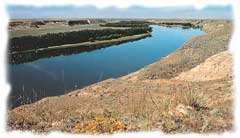
The Missouri River in Montana – Photo courtesy of Travel Montana
The journey up and downwards the Missouri River was to comprise 5,000 miles of the expedition's full mileage of viii,000. It was their waterway n and due west across the territory called the Louisiana Purchase, land the Us had recently purchased from French republic for $15 million, and which doubled the size of the country.
Information technology was this land that President Jefferson saw as key to the westward expansion of the U.s.. It would link the land to the east and the "Oregon Country," which had previously been claimed by the Usa.
Jefferson was among those who dreamed of a Northwest Passage - one river or a series of connected rivers that would cross the western mountains and accomplish the Pacific Ocean. Was the Missouri River the cardinal to this legendary Northwest Passage?
Like the French and Spanish explorers who had begun their exploration of this river some 300 years earlier, President Jefferson hoped so. Lewis and Clark were well on their mode to finding this out.
Every bit they traveled further n and west every twenty-four hours, the experiences of this Corps were inextricably linked with the water that moved them along their class.
Virtually a village of Omaha Indians close to present-day Sioux City, Iowa, Clark wrote near a successful fishing trip. "I went with 10 men to a creek damed by the beavers virtually half style to the hamlet. With some pocket-sized willows & bark we made a elevate and hauled up the creek, and cought 318 fish of different kind i.e. pike, bass, salmon, perch, red horse, small cat, and a kind of perch called silvery fish on the Ohio."
President Jefferson as well directed the Corps of Discovery to inform all the inhabitants they met of the acquisition by the United States of the country in the Louisiana Purchase. They did this in meetings with each Indian tribe along the way, their first official one occurring due north of present-day Omaha, when they met with a modest delegation of Oto and Missouri Indians. During the Corps' kickoff coming together with a Sioux tribe, a grand quango was held with the Yankton Sioux at a site below Calumet Bluff, near nowadays-day Yankton, Due south Dakota.
Food in Abundance
It was here they encountered an affluence of food sources - they shot their commencement buffalo and feasted on deer and elk. The plums, grapes and buffalo berries were abundant. And here the captains recorded their first-always scientific clarification of a pronghorn antelope.
In the following days they encountered bluffs along the river that appeared to be on fire. Fume and steam pouring out of the earth's surface created the expect of a fire without the flames that can still be seen on a rare occurrence today.
They arrived at the Grand Detour or Big Curve region on September xxx, which is south of present-twenty-four hour period Pierre. They set up camp on a sandbar forth the river. Early the side by side morning, as they were sleeping, the sandbar started to give manner. Quickly loading their boats, they shoved off simply as their campsite tumbled in to the h2o.
During the adjacent three weeks, they encountered Dakota and Teton Sioux (also known as Lakota) and Arikara encampments.
Their coming together with the Tetons was not as cordial as information technology had been with the Yanktons. The Tetons demanded one of the Corps' boats equally a toll for moving farther upriver. In what was to be a iii-solar day collision, the Teton stood in ranks on the depository financial institution of the Missouri River as they prepared to fire arrows down upon the expedition. Expedition members aimed back with their hinge guns. This bear witness of forcefulness, perhaps even more importantly, the diplomatic intervention by Teton Chief Black Buffalo, diffused the standoff and allowed the Corps to move further up the river.
On October 8, they spent several peaceful days at an Arikara village. The Arikara were especially fascinated past Clark's black servant, York, who enjoyed the attending.
It was Oct xiv when the expedition entered what today is Northward Dakota, camping near the mouth of 4 Mile Creek, 5 miles south of today'southward boondocks of Fort Yates and meeting more than Arikara. A disarming sign of winter came a week later when the first snow fell. They reached their winter camp destination of the Pocketknife River Indian Villages on Oct 26.
Well accustomed to white visitors, this hub of fur trade commerce in the Upper Missouri welcomed the Corps of Discovery. The welcoming nature of the Mandan and Hidatsa people, also as the gifts they were given, won over the earth guild people. Sheheke or Big White, the chief of the lower Mandan hamlet, told Lewis and Clark: "Our wish is to be at peace with you... If we eat, you shall eat; if we starve, yous must starve also."
Fort Mandan Winter
Clark chose to locate Fort Mandan on the due east bank of the Missouri River, at a altitude from all the villages then the fort would non be associated with whatever one item Indian village.
Throughout their wintertime at Fort Mandan, the explorers prepared for the side by side leg of their journey. In early Apr they sent a coiffure downstream in keelboats dorsum to St. Louis. The boats were filled with letters, journals, reports of their scientific and geographical gathering, Indian artifacts and vocabularies and hundreds of mineral, botanical and animal specimens. Amidst these animal specimens were a living prairie dog and a magpie. These materials were to exist delivered to President Jefferson.
Those remaining at Fort Mandan, a group of 32 people and Lewis'due south dog, a Newfoundland chosen Seaman, launched 6 canoes and two pirogues and "proceeded on" northwest on the Missouri April 7, 1805. With them were French-Canadian trader and interpreter Pierre Charbonneau, his wife Sakakawea, a xv-twelvemonth-old Shoshone who had been captured past the Hidatsa a few years earlier almost the Iii Forks surface area of nowadays-day Montana. The youngest fellow member of the Corps was their infant Jean Baptiste, born that Feb and nicknamed "Pomp." (Sakakawea, which means "bird woman" in the Hidatsa language, is also referred to as Sacagawea or Sacajawea.)
During this Fort Mandan winter, Lewis and Clark had asked many questions about the upper Missouri and what was ahead. Maps had up until now guided them. At present going forward without maps, they advisedly listened to what the Indians and trappers told them to expect. Much, only non all, of this information was helpful and accurate.
On April seven, 1805 - upon leaving Fort Mandan Lewis wrote: We were now about to penetrate a country at least ii m miles in width, in which the foot of civilized homo had never trodden; the proficient and evil information technology had in store was for experiment yet to determine.
Jump was upon the Upper Plains and the river water was high. Clark recorded in his journal seeing buds on the maple, elm, arrowwood and cottonwood copse. The mosquitoes, which were to torment them throughout their time on the water, were as well back. Half-dozen days after their divergence, they neared the mouth of the Little Missouri River in present-day northwestern N Dakota. A potent wind began blowing, making the waters rough. Both captains were on shore when this squall struck and well-nigh dumped the precious cargo of supplies, trade appurtenances, journals and maps that were on the boats. Charbonneau was at the captain and panicked when the nearly accident took place, making matters worse. Sakakawea, on the other hand, kept a level head and is credited with salvaging many items valuableto the expedition.
A Jump Launching
Strong winds and cold temperatures challenged the Corps as it moved toward the confluence of the Missouri with the Yellowstone River in late April. They noted that this confluence, situated on today's North Dakota-Montana state line, would be a good identify to build a fort. It was to be regarded later in the century as one of the river junctions most influential to westward expansion. Onward they proceeded, into what is present-solar day Montana.
On May 8, the Corps came upon a tributary river that had a cloudy advent. Lewis named it accordingly the Milk River, which is located near present-mean solar day Glasgow, Montana. Moving w, they began to detect changes in the land. The prairie grassland of the Groovy Plains they had traveled across since entering present-day South Dakota was disappearing. Sagebrush and pines were appearing, and the outset large horn sheep were sighted.
On May 31, they came upon one of the Missouri River'south well-nigh strikingly cute areas, today known as the White Cliffs of the Missouri, and located nearly the present-solar day boondocks of Havre, Montana. Lewis wrote a lengthy description of these bluffs, describing how water had shaped them into "a thousand grotesque figures, pyramids, and lofty, freestone buildings their parapets well-stocked with statuary... and so perfect indeed are those walls that I should take thought that nature attempted here to rival the homo art of masonry had I not recollected that she had first begun her work."
A Fork in the Road of Water
A few days later on, they arrived at a fork in their route of water. Two keen rivers came together, and the captains were faced with the decision of choosing the correct route. The mountains were somewhere in forepart of them to the w. But they had seen modest ranges n and south, too. Despite scouting alee, it was non clear which was the Missouri or, more than chiefly, which river would have the Corps to the Pacific Ocean. It would exist a disquisitional decision. The crew was of one mind that the north fork was the way. The two captains, after many debates, chose the fork to the due south. The water to the n they named the Marias River, after Lewis'south cousin Maria Wood.
Had they chosen the correct fork? They believed and so when Lewis heard the Great Falls of the Missouri River on June 13. The Hidatsa had told them they were on the correct road if they found a big waterfall. At the Great Falls they constitute not one cascade of h2o over rock, simply five. To cross it, the expedition had to make a difficult, nigh 20-mile portage over land that would cost them a month of valuable time.
The expedition historic the Fourth of July 1805 at the Great Falls. Their route up the Missouri River at the Great Falls moved southwest, not west toward the mountains. Then, every bit they passed through the Gates of the Mount on July 19, west of present-day Helena, Montana, the river began its sweep to the southward and to Three Forks. Hither the three rivers they named the Jefferson, Gallatin and Madison come together to form the Missouri River, and they could see the intimidating peaks of the Rockies. With the view of these mountains alee, the explorers were concerned nigh how they would cantankerous them.
Three Forks was where Sakakawea had been kidnapped years earlier by Hidatsa warriors. Here she began to recognize familiar landmarks, but the Shoshone were not there. The Corps chose the narrow and rocky Jefferson River equally its next waterway, slowly moving ahead, all along battling intense currents and icy river twists.
They fabricated a decision to split upwardly, with Lewis and iii other men mounting a country search for the Shoshone, leaving Clark and the others to keep to navigate the Jefferson. On August xi, Lewis saw a alone mounted Indian, the first the expedition had seen since leaving Fort Mandan. The Indian rode off equally Lewis tried to make contact with him, and two days later he establish a larger group of Shoshone. On Baronial 12, Lewis became the offset white man to cross the Continental Divide.
At the Continental Divide, Lewis began to grasp that a crucial mission of the trek would not be realized. The explorers and President Jefferson had hoped that the source of the Columbia River would be nearby - the last link of the Northwest Passage they dreamed existed. Instead of another river, Lewis faced a wall of mountains standing between himself and the Pacific Ocean. At that signal, he knew there was no easy water route to the Pacific, at least using the Missouri River.
The next x months were to test the character and determination of the Corps of Discovery to degrees that had not yet been experienced. In what has been chosen ane of the country's greatest historical coincidences, the master of the Shoshone tribe they met was Sakakawea'due south brother, Cameahwait. This reunion with her blood brother, which took place at Camp Fortunate, the present location of Clark Canyon Reservoir. The meeting brought assurance that the Corps would exist met with peace and cooperation.
Ii weeks later, they were traveling north overland, with 29 horses, 1 mule and a Shoshone guide named Old Toby. They traveled over a mount pass and into the Bitterroot River Valley. Proceeding on out of nowadays-day Montana over the Bitterroot Mountains, they were back to water travel when they reached the Clearwater River nigh what is now Orofino, Idaho. With the river'south electric current at their back for the commencement time, they swiftly moved down the Clearwater and the Snake Rivers, reaching the Columbia October 16, 1805. They wintered at the s side of the Columbia well-nigh present-twenty-four hours Astoria, Oregon, edifice Fort Clatsop.
Their return trip east began on March 23, 1806, taking once more the Columbia and Clearwater river routes that had brought them westward. On April 21, they left the Clearwater and connected overland. Twelve days after, the terminal of the dried meat and dogs were divided among the political party. On May iv, the Corps was reunited with the Nez Perce, the people they first met on their trip due west.
Considering information technology was likewise early to cross the snow-filled passes through the mountains, they stayed with the Nez Perce until June 24. Continuing their journey, they traveled 156 miles in six days to Traveler'due south Residuum, simply half the fourth dimension it took to comprehend the aforementioned ground on the fashion out. They credited this improved time to better guides and not getting lost.
Still holding out a glimmer of promise that a Northwest Passage could be constitute, the Corps divided into two groups. Clark and his grouping headed southeast to the Yellowstone River traveling across Shoshone lands. Again, Sakakawea provided valuable guide services, pointing out Indian trails that led to the Yellowstone. Clark and his party once once again made dugout canoes and explored the river downstream to its confluence with the Missouri. Despite this rather complicated render trip, they met upwardly with each other at Reunion Bay on August 12, simply two days shy of the Pocketknife River.
Reaching the Mandan villages meant rubber, nutrient and shelter and a reunion with friends made during the 1804-5 wintertime. The captains paid Toussaint Charbonneau for his equus caballus, teepee and services – some $500, with no compensation for Sakakawea. After a three-day stay, the remaining members of the Corps of Discovery, along with Mandan Main Sheheke, pushed off for St. Louis.
On this render trip south, they again marveled at the spectacle of arable wild animals they had seen on their trip. On August 29, in nowadays-day South Dakota, Clark wrote, "I assended to the loftier land and from an eminance I had a view... of a greater number of buffalow than I had ever seen before at one time. I must have seen near twenty,000 of those animals feeding on this plain."
The Corps of Discovery pulled into dock at St. Louis on September 23, 1806, greeted past thanks from a large crowd. Two years, four months and 10 days had passed since they had left there, and many had given upwards whatever promise of seeing them once again. They had covered more than 8,000 miles and had seen sights and set foot where no American had e'er been before.
Lewis and Clark may non accept discovered a straight Northwest Passage, but they did forge a path to the Pacific that would inspire thousands of others to settle in the northwestern United states in the century to follow.
Source: https://www.usbr.gov/gp/lewisandclark/waterway.html
0 Response to "Pacific Ocean Clip Art Lewis and Clark Expedition Map"
Enregistrer un commentaire