what did jackie robinson do besides baseball to help the civil rights
WB
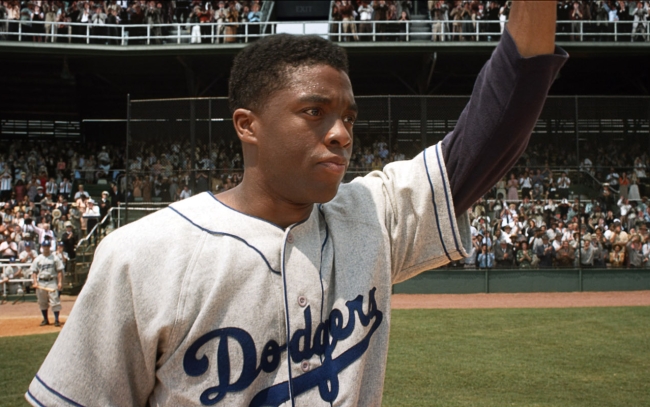
One of America's most iconic and inspiring stories—Jackie Robinson breaking baseball'due south colour line in 1947—is retold in the film 42, which opens nationally this weekend. Even if you're not a baseball fan, the film volition tug at your heart and take you lot rooting for Robinson to overcome the racist obstacles put in his way. It is an uplifting tale of backbone and determination that is difficult to resist, even though you lot know the outcome before the moving-picture show begins.
Merely despite bravura performances by relatively unknown Chadwick Boseman as Robinson and superstar Harrison Ford equally Branch Rickey (the Brooklyn Dodgers' general manager who recruited Robinson and orchestrated his transition from the Negro Leagues to the all-white Major Leagues), the film strikes out as history, because it ignores the true story of how baseball's apartheid system was dismantled.
Related Story
The moving-picture show portrays baseball's integration as the tale of ii trailblazers—Robinson, the antagonistic athlete and Rickey, the shrewd strategist—contesting baseball's, and lodge's, bigotry. But the truth is that information technology was a political victory brought about by a social protest movement. As an activist himself, Robinson would likely take been disappointed past a movie that ignored the axis of the broader civil rights struggle.
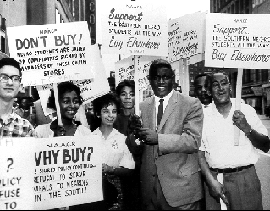
That story has been told in ii outstanding books, Jules Tygiel'south Baseball game's Great Experiment (1983) and Chris Lamb'south Conspiracy of Silence: Sportswriters and the Long Campaign to Desegregate Baseball (2012). As they recount, Rickey's plan came after more a decade of effort by black and left-fly journalists and activists to desegregate the national pastime. Start in the 1930s, the Negro press, civil rights groups, the Communist Party, progressive white activists, and radical politicians waged a sustained campaign to integrate baseball game. It was function of a broader move to eliminate discrimination in housing, jobs, and other sectors of society. It included protests against segregation within the military, mobilizing for a federal anti-lynching police force, marches to open upwards defense force jobs to blacks during World War Two, and boycotts against stores that refused to rent African Americans under the banner "don't shop where you tin can't work." The movement accelerated later on the war, when returning black veterans expected that America would open up upwards opportunities for African Americans.
Robinson broke into baseball when America was a deeply segregated nation. In 1946, at least vi African Americans were lynched in the Due south. Restrictive covenants were still legal, barring blacks (and Jews) from buying homes in many neighborhoods—not but in the Due south. Just a handful of blacks were enrolled in the nation's predominantly white colleges and universities. There were only two blacks in Congress. No large city had a black mayor.
It is difficult today to summon the excitement that greeted Robinson's accomplishment. The dignity with which Robinson handled his encounters with racism—including verbal and physical abuse on the field and in hotels, restaurants, trains, and elsewhere—drew public attention to the issue, stirred the consciences of many white Americans, and gave blackness Americans a tremendous heave of pride and cocky-confidence. Martin Luther King Jr. one time told Dodgers star Don Newcombe, another one-time Negro Leaguer, "Y'all'll never know what you and Jackie and Roy [Campanella] did to get in possible to do my chore."
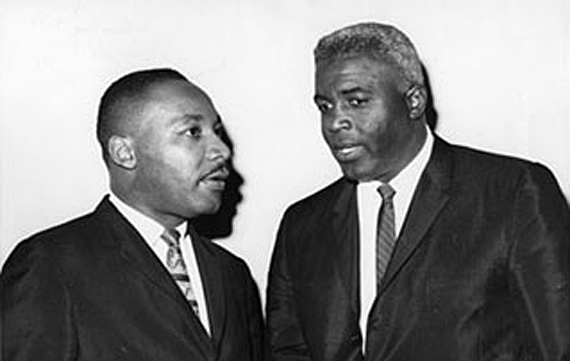
Jackie Robinson, right, and Martin Luther King, Jr. (Solipsis)
Robinson, who spent his entire major league career (1947 to 1956) with the Dodgers, was voted Rookie of the Twelvemonth in 1947 and Almost Valuable Player in 1949, when he won the National League batting title with a .342 batting average. An outstanding base runner and base stealer, with a .311 lifetime batting average, he led the Dodgers to 6 pennants and was elected to the Hall of Fame in 1962.
42 is the fourth Hollywood film most Robinson. All of them suffer from what might be called movement myopia. Nosotros may prefer our heroes to be rugged individualists, just the reality doesn't conform to the myth embedded in Hollywood'due south version of the Robinson story.
In The Jackie Robinson Story, released in 1950, Robinson played himself and the fabled Ruby Dee portrayed his wife Rachel. Produced at the top of the Cold War, five years before the Montgomery bus cold-shoulder, the moving picture celebrated Robinson'due south feat as show that America was a land of opportunity where anyone could succeed if he had the talent and volition. The movie opens with the narrator saying, "This is a story of a boy and his dream. But more than than that, it's a story of an American boy and a dream that is truly American."
In 1990 TNT released a made-for-Television receiver moving-picture show, The Courtroom Martial of Jackie Robinson, starring Andre Braugher, which focused on Robinson'due south battles with racism as a soldier during World War II. In 1944, while assigned to a training camp at Fort Hood in segregated Texas, Robinson, a 2nd lieutenant, refused to move to the back of an army bus when the white driver ordered him to do and so, even though buses had been officially desegregated on war machine bases. He was court martialed for his insubordination, tried, acquitted, transferred to some other military base, and honorably discharged four months later. Past depicting Robinson as a rebellious effigy who chafed at the blatant racism he faced, the moving-picture show foreshadows the traits he would have to initially suppress once he reached the majors.
HBO's The Soul of the Game, released in 1996, focused on the hopes and then the frustrations of Satchel Paige and Josh Gibson, the two greatest players in the Negro Leagues, whom Branch Rickey passed up to integrate the majors in favor of Robinson, played by Blair Underwood. Rickey had long wanted to hire blackness players, both for moral reasons and because he believed it would increase ticket sales amid the growing number of African Americans moving to the big cities. He knew that if the experiment failed, the cause of baseball integration would be set back for many years. Rickey's scouts identified Robinson—who was playing for the Negro League'southward Kansas Urban center Monarchs subsequently leaving the army—as a potential bulwark-breaker. Rickey could have chosen other Negro League players with greater talent or more name recognition, simply he wanted someone who could be, in today'south terms, a office model. Robinson was young, articulate and well educated. His female parent moved the family unit from Georgia to Pasadena, California in 1920 when Robinson was 14 months ago. Pasadena was deeply segregated, just Robinson lived among and formed friendships with whites growing upwardly there and while attending Pasadena Inferior College and UCLA. He was UCLA's first four-sport athlete (football game, basketball, runway, and baseball), twice led the Pacific Coast League in scoring in basketball, won the NCAA broad jump championship, and was a football All-American. Rickey knew that Robinson had a hot temper and strong political views, but he calculated that Robinson could handle the emotional pressure while helping the Dodgers on the field. Robinson promised Rickey that, for at to the lowest degree his rookie twelvemonth, he would not respond to the inevitable verbal barbs and even physical abuse he would face on a daily basis.
In 1997, America historic Robinson with a proliferation of conferences, museum exhibits, plays, and books. Major League Baseball retired Robinson'due south number—42—for all teams. President Beak Clinton appeared with Rachel Robinson at Shea Stadium to venerate her late married man.
But the adjacent Hollywood pic about Robinson didn't get in until this year'due south 42, written and directed by Brian Helgeland (screenwriter of L.A. Confidential and Mystic River), nether the auspices of Warner Brothers and Legendary Pictures. The real story of baseball game's integration has plenty of drama and could have easily been incorporated into the moving-picture show.
Starting in the 1930s, reporters for African-American papers (specially Wendell Smith of the Pittsburgh Courier, Fay Immature of the Chicago Defender, Joe Bostic of the People's Voice in New York, and Sam Lacy of the Baltimore Afro-American), and Lester Rodney, sports editor of the Communist paper, the Daily Worker, took the pb in pushing baseball'south establishment to hire black players. They published open up letters to owners, polled white managers and players (some of whom were threatened by the prospect of losing their jobs to blacks, simply most of whom said that they had no objections to playing with African Americans), brought black players to unscheduled tryouts at bound training centers, and kept the consequence before the public. Several white journalists for mainstream papers joined the chorus for baseball integration.
Progressive unions and civil rights groups picketed outside Yankee Stadium the Polo Grounds, and Ebbets Field in New York Urban center, and Comiskey Park and Wrigley Field in Chicago. They gathered more than a million signatures on petitions, demanding that baseball game tear down the color barrier erected by team owners and Commissioner Kennesaw Mountain Landis. In July 1940, the Trade Union Athletic Clan held an "Terminate Jim Crow in Baseball" demonstration at the New York Earth'southward Fair. The next year, liberal unions sent a delegation to meet with Landis to need that major league baseball recruit blackness players. In Dec 1943, Paul Robeson, the prominent black player, singer, and activist, addressed baseball's owners at their annual winter coming together in New York, urging them to integrate their teams. Nether orders from Landis, they ignored Robeson and didn't ask him a single question.
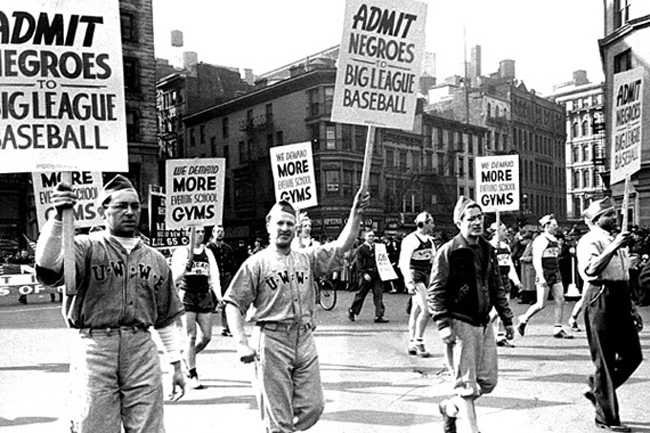
National Endowment for the Humanities
In 1945, Isadore Muchnick, a progressive member of the Boston City Council, threatened to deny the Red Sox a let to play on Sundays unless the team considered hiring black players. Working with several black sportswriters, Muchnick persuaded the reluctant Red Sox general manager, Eddie Collins, to give 3 Negro League players—Robinson, Sam Jethroe, and Marvin Williams—a tryout at Fenway Park in April of that twelvemonth. The Sox had no intention of signing any of the players, nor did the Pittsburgh Pirates and Chicago White Sox, who orchestrated similar artificial auditions. Merely the public pressure and media publicity helped raise awareness and furthered the cause.
Other politicians were allies in the crusade. Running for re-election to the New York City Council in 1945, Ben Davis—an African-American quondam college football star, and a Communist—distributed a leaflet with the photos of two blacks, a expressionless soldier and a baseball game thespian. "Proficient enough to die for his country," information technology said, "but non skilful enough for organized baseball." That year, the New York State legislature passed the Quinn-Ives Act, which banned bigotry in hiring, and soon formed a committee to investigate discriminatory hiring practices, including ane that focused on baseball. In short order, New York City Mayor Fiorello LaGuardia's established a Committee on Baseball game to push button the Yankees, Giants, and Dodgers to sign blackness players. Left-wing Congressman Vito Marcantonio, who represented Harlem, chosen for an investigation of baseball'due south racist practices.
This protest movement set the stage for Robinson'south archway into the major leagues. In October 1945, Rickey announced that Robinson had signed a contract with the Dodgers. He sent Robinson to the Dodgers' minor-league team in Montreal for the 1946 flavor, then brought him upwards to the Brooklyn squad on opening day, April 15, 1947.
The Robinson experiment succeeded—on the field and at the box office. Within a few years, the Dodgers had hired other black players—pitchers Don Newcombe and Joe Black, catcher Roy Campanella, infielder Jim Gilliam, and Cuban outfielder Sandy Amoros—who helped turn the 1950s Dodgers into i of the greatest teams in baseball history.
Viewers of 42 will see no show of the movement that made Robinson'south—and the Dodgers'—success possible. For instance, Andrew Holland plays Pittsburgh Courier reporter Wendell Smith, only he's depicted as Robinson'south traveling companion and the ghost-writer for Robinson's newspaper column during his rookie season. The film ignores Smith'due south key office equally an agitator and leader of the long crusade to integrate baseball before Robinson became a household proper name.
Robinson recognized that the dismantling of baseball's color line was a triumph of both a man and a motion. During and after his playing days, he joined the civil rights cause, speaking out—in speeches, interviews, and his column—against racial injustice. In 1949, testifying before Congress, he said: "I'm non fooled because I've had a chance open to very few Negro Americans."
Robinson viewed his sports celebrity equally a platform from which to challenge American racism. Many sportswriters and about other players—including some of his fellow black players, content simply to be playing in the majors—considered Robinson as well aroused and vocal almost racism in baseball and society.
When Robinson retired from baseball game in 1956, no squad offered him a position equally a motorcoach, director, or executive. Instead, he became an executive with the Brimming Full o' Nuts restaurant chain and an advocate for integrating corporate America. He lent his proper name and prestige to several business organisation ventures, including a construction company and a blackness-owned banking concern in Harlem. He got involved in these business organization activities primarily to assistance address the shortage of affordable housing and the persistent redlining (lending discrimination against blacks) by white-owned banks. Both the structure company and the depository financial institution later barbarous on difficult times and dimmed Robinson's confidence in black capitalism as a strategy for racial integration.
In 1960, Robinson supported Hubert Humphrey, the liberal Senator and civil rights stalwart from Minnesota, in his campaign for president. When John Kennedy won the Autonomous nomination, nevertheless, Robinson shocked his liberal fans by endorsing Richard Nixon. Robinson believed that Nixon had a ameliorate runway record than JFK on civil rights issues, but past the end of the campaign—especially after Nixon refused to make an appearance in Harlem—he regretted his choice.
During the 1960s, Robinson was a constant presence at ceremonious rights rallies and picket lines, and chaired the NAACP's fundraising drive. Angered by the GOP'southward opposition to civil rights legislation, he supported Humphrey over Nixon in 1968. But he became increasingly frustrated by the stride of modify.
"I cannot possibly believe," he wrote in his autobiography, I Never Had It Fabricated, published before long earlier he died of a heart attack at age 53 in 1972, "that I have it made while so many blackness brothers and sisters are hungry, inadequately housed, insufficiently clothed, denied their nobility every bit they alive in slums or barely exist on welfare."
In 1952, v years later Robinson broke baseball game'south colour bulwark, but vi of major league baseball's 16 teams had a black player. It was not until 1959 that the concluding holdout, the Boston Ruddy Sox, brought an African American onto its roster. The black players who followed Robinson shattered the stereotype—once widespread among many team owners, sportswriters, and white fans—that at that place weren't many African Americans "qualified" to play at the major league level. Between 1949 and 1960, black players won 8 out of 12 Rookie of the Year awards, and 9 out of 12 Most Valuable Role player awards in the National League, which was much more integrated than the American League. Many former Negro League players, including Willie Mays, Henry Aaron, Don Newcombe, and Ernie Banks, were perennial All-Stars.
But bookish studies conducted from the 1960s through the 1990s uncovered persistent bigotry. For case, teams were likely to favor a weak-hitting white player over a weak-hitting blackness player to exist a benchwarmer or a utility man. And even the all-time blackness players had fewer and less lucrative commercial endorsements than their white counterparts.
In the sixteen years he lived after his retirement in 1956, Robinson pushed baseball to hire blacks equally managers and executives and fifty-fifty refused an invitation to participate in the 1969 Old Timers game because he did not however see "genuine involvement in breaking the barriers that deny admission to managerial and front role positions." No major league squad had a black manager until Frank Robinson was hired by the Cleveland Indians in 1975. The majors' first blackness general manager—the Atlanta Braves' Pecker Lucas—wasn't hired until 1977.
Last season, players of color represented 38.2 percent of majo- league rosters, according to a written report by the Found for Diverseness and Ideals in Sport at the Academy of Fundamental Florida. Black athletes represented only 8.viii percent of major-league players—a dramatic reject from the elevation of 27 percent in 1975, and less than half the 19 percent in 1995. One quarter of last season'due south African-Americans players were clustered on iii teams—the Yankees, Angels, and Dodgers. Their shrinking proportion is due primarily to the growing number of Latino (27.iii%) and Asian (1.9%) players, including many foreign-born athletes, now populating major league rosters.
Just there are too sociological and economic reasons for the decline of black ballplayers. The semi-pro, sandlot, and industrial teams that once thrived in black communities, serving as feeders to the Negro Leagues and and then the major leagues, accept disappeared. Basketball and football game accept replaced baseball as the nearly popular sports in blackness communities, where funding for public school baseball teams and neighborhood playgrounds with baseball fields has declined. Major league teams more actively recruit immature players from Latin America, who are typically cheaper to hire than black Americans, as Adrian Burgos, in Playing America's Game: Baseball, Latinos, and the Color Line (2007) and Rob Ruck, in Raceball: How the Major Leagues Colonized the Blackness and Latin Game (2012) certificate.
Among today'south 30 teams, there are only iv managers of color—three blacks (the Reds' Dusty Baker, the Astros' Bo Porter, and the Rangers' Ron Washington) and i Latino (the Braves' Fredi Gonzalez). (Two of final season's Latino managers—the Indians' Manny Acta, and Ozzie Guillen of the Marlins—were fired). One Latino (Ruben Amaro Jr. of the Phillies) and ane African American (Michael Hill of the Marlins) serve as general managers. (White Sox GM Ken Williams, an African American, was promoted to executive VP during the off-season.) Arturo Moreno, a Latino, has endemic the Los Angeles Angels since 2003. Basketball game nifty Earvin "Magic" Johnson, part of the new group that purchased the Los Angeles Dodgers last yr, is the start African-American possessor of a major league squad.
Like baseball game, American society—including our workplaces, Congress and other legislative bodies, friendships, and even families—is more than integrated than it was in Robinson's day. Just there is still an ongoing debate about the magnitude of racial progress, as measured past persistent residential segregation, a significantly college poverty rate among blacks than whites, and widespread racism within our criminal justice and prison house systems.
As Robinson understood, these inequities cannot be solved by private effort lone. It also requires grassroots activism and protestation to attain changes in regime policy and business organisation practices. 42, misses an opportunity to recap this important lesson. Robinson's legacy is to remind us of the unfinished agenda of the civil rights revolution and of the important role that movements play in moving the country closer to its ethics.
Source: https://www.theatlantic.com/entertainment/archive/2013/04/the-real-story-of-baseballs-integration-that-you-wont-see-in-i-42-i/274886/
0 Response to "what did jackie robinson do besides baseball to help the civil rights"
Enregistrer un commentaire